
Backing for AI that sees the person, not just the score
Credit unions are about to get something they’ve never had: AI decisioning that checks itself for bias before it lends a penny. As a result, credit unions will be at the front of responsible AI lending in the UK.
NestEgg has won a grant from the Financial Regulation Innovation Lab (FRIL) Responsible AI Innovation Call, run by FinTech Scotland with the University of Strathclyde and funded by Scottish Enterprise. The award backs NestEgg LENS, a project that tests AI lending decisions for bias before they reach a single borrower.
For lenders, it marks a real shift: AI in credit decisioning that treats people as individuals, rather than grouping them into broad risk bands
Fairness measured as rigorously as the bad rate
Most lending models are judged on the bad rate, an economic output. LENS judges them on fairness too, and does it in the open. Initially working with Scottish credit union partners, we will run an interpretable AI model in “shadow mode” alongside live lending decisions. Real applications flow through it, but right now, AI never decides a loan. Every shadow decision is logged with the factors behind it, ready to test.
Built for a sector that’s ready to double
Timing matters. The government has committed to doubling the size of the mutual sector, and common bond reform is set to let credit unions reach far more people. Growth on that scale can’t run on manual underwriting and off-the-shelf scores. Credit unions need decisioning that is fast, explainable and fair at scale.
Additionally, LENS is the foundation for something bigger: credit unions sharing data, with consent, to see what no single lender can see alone. Every decision tested makes the whole network sharper. That’s how credit unions stay ahead of banks and fintechs racing into AI. They won’t do it by copying them, but by leading on fairness.
A fuller picture of every applicant
Meet four applicants.
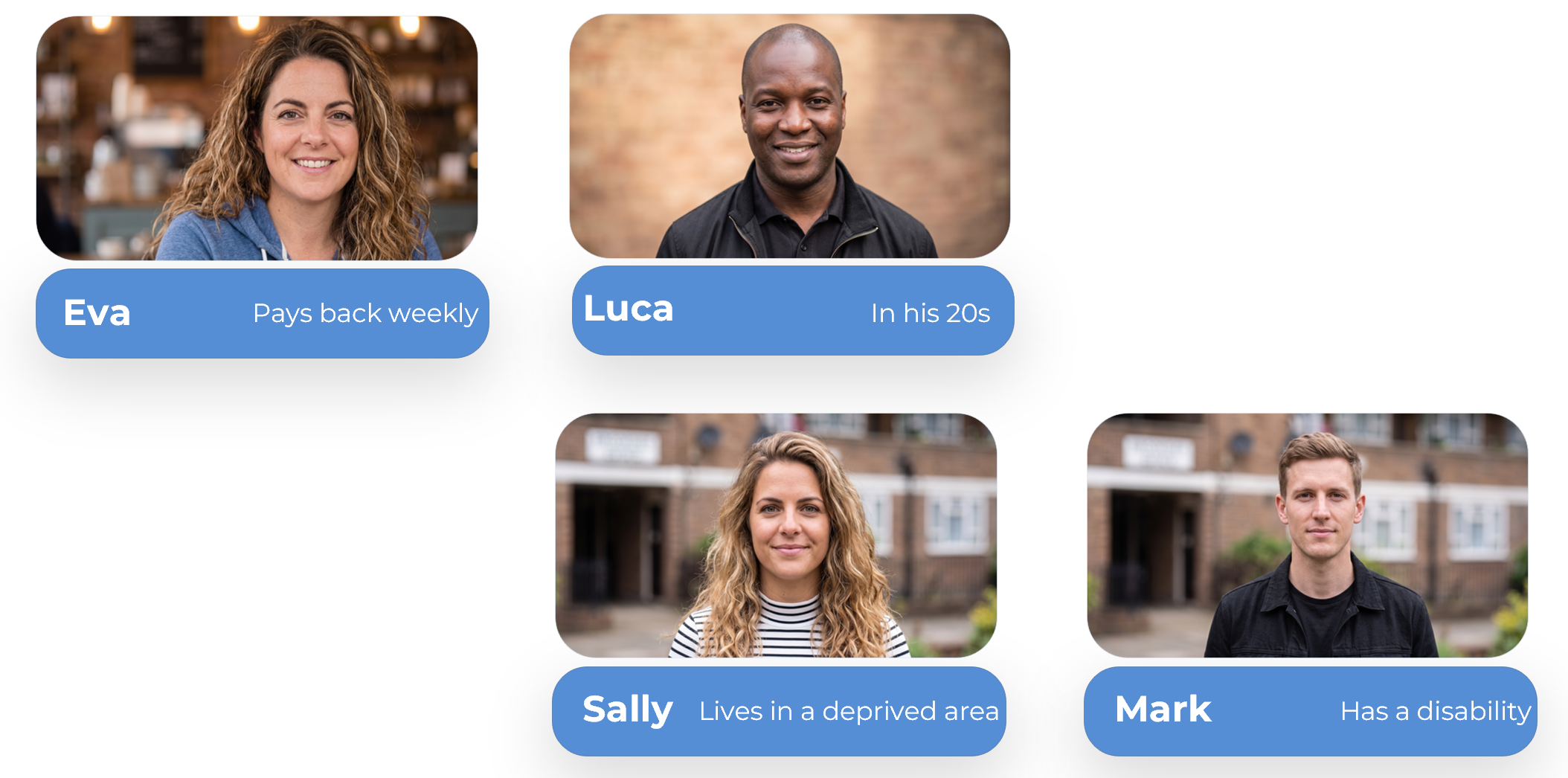
- Eva pays off her Family Loan weekly, but credit scoring prefers monthly payments.
- Luca moved to the UK two years ago, so his credit file is thin.
- Sally lives in a postcode that gets marked down, whatever her own record.
- Mark is paid every four weeks, which can trip up affordability checks built around monthly salaries.
On paper, each could look like a higher risk, for reasons that say little about whether they will repay. Biases within the existing credit system can often lead to a decline.
With bias testing built in from the start, the potential gains for borrowers and lenders are significant.
- People assessed as individuals. Decisions draw on how each applicant actually manages their money, not just an off-the-shelf score or the group they appear to belong to.
- More data sources. Open Banking, savings behaviour and credit union loan histories sit alongside traditional credit data to build a fuller picture.
- No hidden proxies. Traditional models can sometimes treat protected characteristics such as gender or disability as risk signals. LENS checks that data, like spending or credit scoring, isn’t quietly
- standing in for them
- More accepted loans. Legacy credit files can be partial and out of date, so creditworthy people might be declined. A fairer, better-informed model could see more of them accepted.
- Faster, explainable decisions. Every decision will come with the reasons behind it. Lenders can see why an application was approved or declined, and borrowers can be told what would need to change for a different answer next time.
A sector first, responsible AI lending as your competitive advantage.
This is AI decisioning arriving in the credit union sector for the first time, just as the sector gears up to grow. It also gives credit unions something to stand out on that banks and fintechs can’t easily copy: fairness they can prove. For lenders, that means:
- Growth with confidence. The chance to lend to more of the people you exist to serve, backed by evidence that decisions are fair.
- Consumer Duty evidence. Audit trails, decision logs and management information built in from day one, not assembled after the fact.
- Explanations you can stand behind. Clear reasons for every decision, for your team, your borrowers and the regulator.
- Ongoing assurance. Drift monitoring that catches fairness problems as populations change, continuing beyond the life of the project.
The opportunity is clear: the credit unions that move now will set the standard for fair AI lending, not follow it. If you’d like to be part of this groundbreaking project, get in touch.
Book a demo now

Get insights into responsible lending
Enter your email to get insights once or twice a month
No spam. Unsubscribe anytime.